Showing posts with label history. Show all posts

Saturday, July 15, 2017

Know Indian Culture: NATRAJ

Shiva as Lord of the Dance (“Nataraja”—nata meaning dance or performance, and raja meaning king or lord)
The visual form of Nataraja has Shiva with four arms dancing within a circle of flames (the prabhamandala.) lifting his left leg and standing on a dwarf, Apasmara, who symbolizes ignorance.
His upper right hand holds the drum of creation (hourglass-shaped drum), beating the pulse of the universe and also music for Shiva’s dance. 
The drum, called udukkai in Tamil, represents sound as the first element of an unfolding universe. 
In his upper left hand, Nataraja holds the fire of destruction, which according to Hindu mythology is the instrument of annihilation at the end of each cycle of creation. These two symbols, therefore, illustrate the intricate balance of the forces of creation and destruction in the universe.
Front right hand is in the abhaya mudra (the “fear-not” gesture, made by holding the palm outward with fingers pointing up.
The uplifted left leg signifies revealing grace that liberates souls from bondage.
The lower left hand, meanwhile, which points to the uplifted leg in assurance that Shiva’s foot is a refuge for all true believers, and surrender to God is the path to liberation.
In classic Sanskrit treatises on dance, this form, the most common representation of Nataraja, is called the bhujamgatrasa (“trembling of the snake”).
Shiva’s third eye is open. The destruction he brings is not blind but serves a purpose. And the open third eye, of the Ajna chakra of Wisdom symbolizes that he can see what we cannot. The stars and planets are entangled in his hair as ornaments which gives the universe itself.
The ring of fire around the figure of Nataraja represents the manifest universe.
Lotus pedestal on which the entire image rests places this universe within the heart or consciousness of each person. 
The flowing hair of Lord Shiva in his dance symbolizes a rejection of society, showing Shiva as an ascetic.
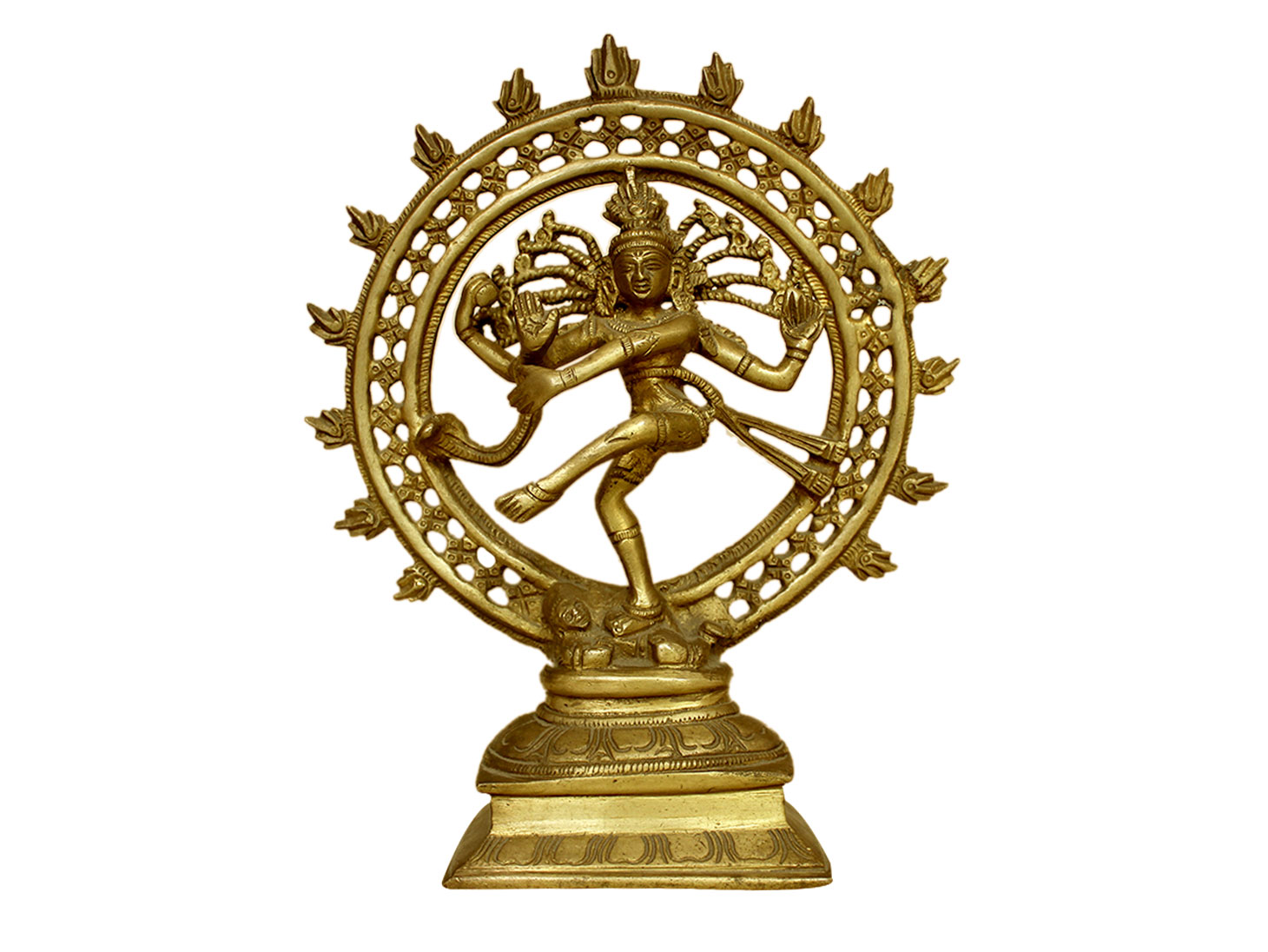
The figures of Ganges, crescent moon and skull are also usually found in Nataraja sculptures, and are common symbols of Lord Shiva. 
The snake around the waist of Nataraja represents the ‘kundalini,’ or divine force found in all beings.
The gestures of the dance represent Shiva’s five activities (panchkritya):
  1. shrishti(creation)
  2. Sthiti (preservation)
  3. Samhara (destruction)
  4. Tirobhava (illusion), and
  5. Anugraha (grace or salvation).

IT is a dual statement of stillness and motion, the static sculpture representing the intense activity of Lord Shiva. The stoic face of Lord Shiva represents his composure and neutrality, unaffected and above all forces.

Monday, June 19, 2017

Contents of Indika

Contents of Indika:
  • Economy. Gold, silver, copper and iron are abundant on Indian soil. Besides, tin and other metals are used for making a number of tools, weapons, ornaments, and other articles. No famines have ever occurred in India because of the following reasons:

1.     The Indians are always assured of at least one of the two seasonal crops.
2.     There are a number of spontaneously growing fruits and edible roots available.
3.     The Indian warriors regard those engaged in agriculture and animal husbandry as sacred. Unlike the warriors in other countries, they do not ravage farms during war conquests. Moreover, the warring sides never destroy the enemy land with fire or cut down its trees.
  • Society. The population of India is divided into 7 endogamous and hereditary castes:

1.     Philosophers- Believed to be most dear to the gods, and to be the most conversant with matters pertaining to Hades. At the beginning of the year, they make prophecies about droughts, rain storms, propitious winds, diseases and other topics. Based on these prophecies, the citizens and the rulers make adequate preparations. A philosopher whose prophecy fails receives strong criticism and has to observe silence for the rest of his life, but otherwise incurs no penalty.
2.     Farmers- Most numerous of all castes. Live in villages and protected from damage during wars, even by enemy warriors.
3.     Herders- Live in tents, outside villages and towns. Hunt and trap crop-destroying birds and animals
4.     Artisans- Exempted from paying taxes, and receive a maintenance from the state exchequer
5.     Military- Maintained at state expense, along with war horses and elephants
6.     Overseers
7.     Councillors and Assessors- Composed of wise people with good character
  • Administration. The foreigners are treated well. Special officers are appointed to ensure that no foreigner was harmed, and judges handed out harsh punishment to those who took unfair advantage of the foreigners. 

Saturday, July 05, 2014

Journey to our Constitution: Indian Councils Act 1861.

This Act undone effect of the 1833 Act inasmuch as it restored the power of legislation to the Governments of Madras and Bombay. Also it made notable changes in the composition of the Governor General's council for executive & legislative purposes.

Changes brought:

Executive purposes.

Council of the Governor General was expanded and a fifth ordinary member was added. Now it included total 7 members (other two members being the Governor General and the commander in Chief).

Legislative purposes.

For the legislative purposes, not less than 6 and not more than 12 members were additionally to be nominated (comprising of both official and non-official members) by the Governor General and they were to hold the office for two years. Out of these, not less than half were required to be Non-Official. 

Similar provisions were enacted for the Governor's Council in provinces of British India.

Portfolio system:

With the Indian Councils Act for the first time Portfolio system started. Each member of the Council of the Governor General was allocated portfolio of a particular department. Lord Canning (1856-1858 as Governor general, 1858-1862 as Viceroy) was the First to start a Portfolio system.
Before the adoption of the portfolio system in the Government of India, the whole business of the Indian governmental business was carried out by the Governor-General-in Council (earlier name of Cabinet Secretariat), As the amount and complexity of business of the Government increased, the work of the various departments was distributed amongst the members of the Council: only the more important cases were dealt with by the Governor-General or the Council collectively.

Criticism:

  1. Though the non-official members were added, the councils were neither a deliberative nor a representative body as these members could only consider the proposals kept before them by the Governor-General. But they could not criticise it.
  2. The Governor -General was given overriding powers inasmuch as it enjoyed the powers of prior sanction, without which a bill could not be introduced in the assembly. Also, it enjoyed the ordinance making power in situation of emergency, having the force of Act of the Council. He could also veto a bill after it was passed.

Saturday, June 07, 2014

Journey to our Constitution: Charter Act 1833

Impact on trade.

The Charter Act of 1833 was the 20 years renewal of the charter in 1813. As per this Charter, the company was asked to close its commercial business. 
  • Thus, this time the charter was renewed on the condition that Company should abandon its trade entirely, alike with India and China, and permit Europeans to settle freely in India. 
  • The company lost its monopoly in China and also the trade of tea, granted by Charter act of 1813.

Legislative journey of India.

  • This act made the Governor General of Bengal the Governor General of British India and all financial and administrative powers were centralized in the hands of Governor General-in-Council. Thus with Charter Act of 1833, Lord William Bentinck became the “First Governor General of British India”. 
  • The number of the members of the Governor General's council was again fixed to 4, which had been reduced by the Pitt's India act. However, certain limits were imposed on the functioning of the 4th member. The 4th member was NOT entitled to act as a member of the council except for legislative purposes. 
  • First fourth person to be appointed as the member of the Council was Lord Macaulay.
  • It deprived the Governor of Bombay and Madras of their legislative powers. The Governor-General was given exclusive legislative powers for the whole of British India.

Enhanced power of Governor-General of India.

He could repeal, amend or alter any laws or regulations including all persons (whether British or native or foreigners), all places and things in every part of British territory in India, for all servants of the company, and articles of war. 
However, the Court of Directors acting under the Board of control could veto any laws made by the Governor-General-in-Council.
Governor-General's Government was referred to as the Government of India for the first time.

Codification of laws.

The charter act of 1833 is considered to be an attempt to codify all the Indian Laws.
  • The British parliament as a supreme body, retained the right to legislate for the British territories in India and repeal the acts. 
  • The act of 1833 provided that all laws made in India were to be laid before the parliament and were to be known as Acts. 
  • In a step towards codifying the laws, the Governor-General-in-Council was directed under the Charter act of 1833, to set up an Indian law Commission.

First Indian Law Commission. 

The first law commission was set up by the Charter act of 1833 and Lord Macaulay was its most important member and Chairman. 
  • The other members of this commission were English barrister Cameron, Macleod of Madras service, William Anderson of Bombay Service and Sir William McNaughton of the Calcutta Service. Sir William McNaughton did not accept the appointment. 
  • The objectives of the law commission was to inquire into the Jurisdiction, powers and rules of the courts of justice police establishments, existing forms of judicial procedure, nature and operation of all kinds of laws. 
  • It was directed that the law Commission shall submit its report to the Governor General-in-council and this report was to be placed in the British parliament.

Indians in the Government service.

The Charter act of 1833 was the first act which provisioned to freely admit the natives of India to share an administration in the country. 

Mitigation of Slavery.


This act also directed the Governor General-in-Council to adopt measures to mitigate the state of slavery, persisting in India since sultanate Era. The Governor General-in-Council was also directed to pay attention to laws of marriage, rights and authorities of the heads of the families, while drafting any laws.

More Bishops.


The number of British residents was increasing in India. The charter act of 1833 laid down regulation of establishment of Christian establishments in India and the number of Bishops was made 3. (Bishop is an ordained or consecrated member of the Christian clergy who is generally entrusted with a position of authority and oversight).

NEXT: Charter Act 1853.