
Showing posts with label 12th Auto Expo. Show all posts
Showing posts with label 12th Auto Expo. Show all posts
Thursday, July 13, 2017


Saturday, August 09, 2014
Article about working of GTO.
Friends, I came across a very useful article about the definition and and working of the orbits, in which the satellites are placed. Here is the excerpt of the post by Jason Davis.
How to get a satellite to geostationary orbit.
As I wrote about the GSLV-D5 mission, I was tempted to include this standard informational line, punched directly out of the press kit:
The satellite was placed into a geostationary transfer orbit with a perigee of about 180 kilometers, an apogee of about 36,000 kilometers and an inclination of 19.3 degrees.
But unless you’re familiar with basic orbital mechanics, that sentence doesn’t have much meaning. What’s a transfer orbit? Is there a difference between geostationary and geosynchronous? Why is there such a wide range between the perigee and apogee?
For help explaining all of this, I turned to Mike Loucks of The Astrogator’s Guild. The Astrogator’s Guild uses a software package called STK/Astrogator from Analytical Graphics Inc. that is used to help spacecraft mission managers plan the trajectories of a variety of space missions. The software has been used on numerous NASA missions, including WMAP, LRO, LCROSS, New Horizons, Messenger, LADEE and MAVEN.
The first concept I want to tackle is the difference between a geosynchronous and geostationary orbit. Although these terms are often used interchangeably, they are not the same thing:
A Geosynchonous Orbit (GEO) takes a satellite around the Earth at a rate of once per day, keeping it roughly in the same area over the ground.
A Geostationary Orbit (GSO) is a geosynchronous orbit with an inclination of zero, meaning, it lies on the equator.
All geostationary satellites are geosynchronous. Not all geosynchronous satellites are geostationary.
Think of it like this: the “synchronous” part of geosynchronous describes the rate of the satellite’s orbit but says nothing about its inclination—the orbit’s angle with respect to the equator. A geosynchronous satellite with a non-zero inclination will trace out a figure eight in the sky as it dips above and below the equator.
The “stationary” part of geostationary describes how a satellite in this orbit remains fixed with respect to an observer on the ground. This is an ideal orbit for communications satellites, since ground-based antennas can remain pointed at the same spot in the sky.

NASA / University of Texas Center for Space Research
The Earth's gravity field
This animation, created with data from the GRACE spacecraft, shows the variances in Earth's gravity field.
It’s also important to remember that even geostationary satellites drift over time as they are tugged on by the moon and sun’s gravity. For that matter, the Earth’s gravity isn’t uniform, either, so the satellite needs an onboard fuel supply to make slight corrections over time.
What, then, is a transfer orbit? Rockets sending payloads to geosynchronous and geostationary orbits drop off their payload in transfer orbits, halfway points en route to the satellite’s final position. From transfer orbit, a satellite conducts engine burns to circularize its orbit and change its inclination. Both SES-8 and GSAT-14 were bound for geostationary orbits, so we say that the Falcon and GSLV launched their payloads to geostationary transfer orbits.
What does a geostationary transfer orbit look like, and how does the satellite get from there into its final position? Of the two satellites I mentioned, GSAT-14 took the more common route, so we’ll use it as an example. (SES-8 used a supersynchrounous transfer orbit, where the orbital period is longer one day.)
Mike doesn’t have all the parameters required to make an exact GSAT-14 simulation, so he’s made a few assumptions and created a virtual cocktail napkin outline for us to follow.
Let’s revisit the line I struck from my GSLV article:
The satellite was placed into a geostationary transfer orbit with a perigee of about 180 kilometers, an apogee of about 36,000 kilometers and an inclination of 19.3 degrees.
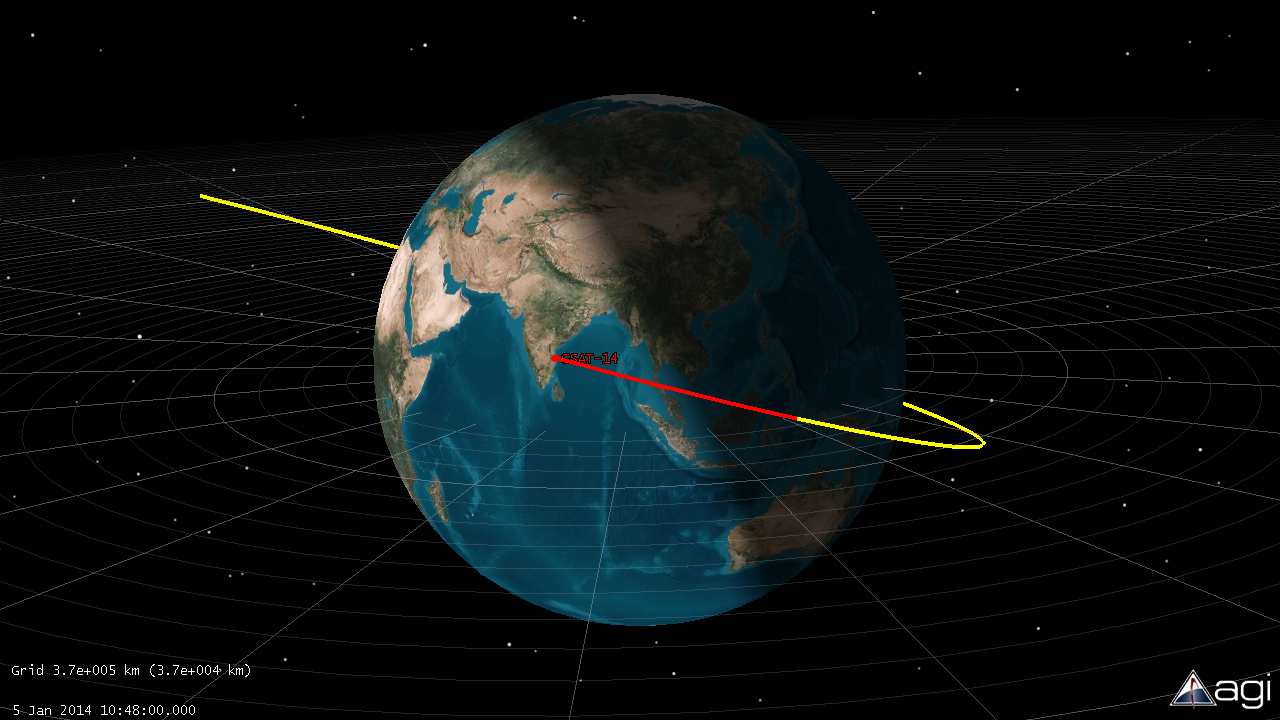
GSAT-14 launched out of India’s Satish Dhawan Space Centre. The mission began in powered flight under the GSLV, which is represented by the red line:
Mike Loucks / SEE
GSAT-14 powered flight and coast
When it hit the equator, the GSLV finished its share of the work and released GSAT-14. This point in the orbit is our descending node. Ascending and descending nodes are just fancy ways of saying you crossed the equator in either a southbound (descending) or northbound (ascending) direction. For a geostationary transfer orbit, the descending node is also at perigee, the orbit’s lowest point. Here, GSAT's altitude is 180 kilometers. For comparison, the International Space Station has a typical altitude of just over 400 kilometers.
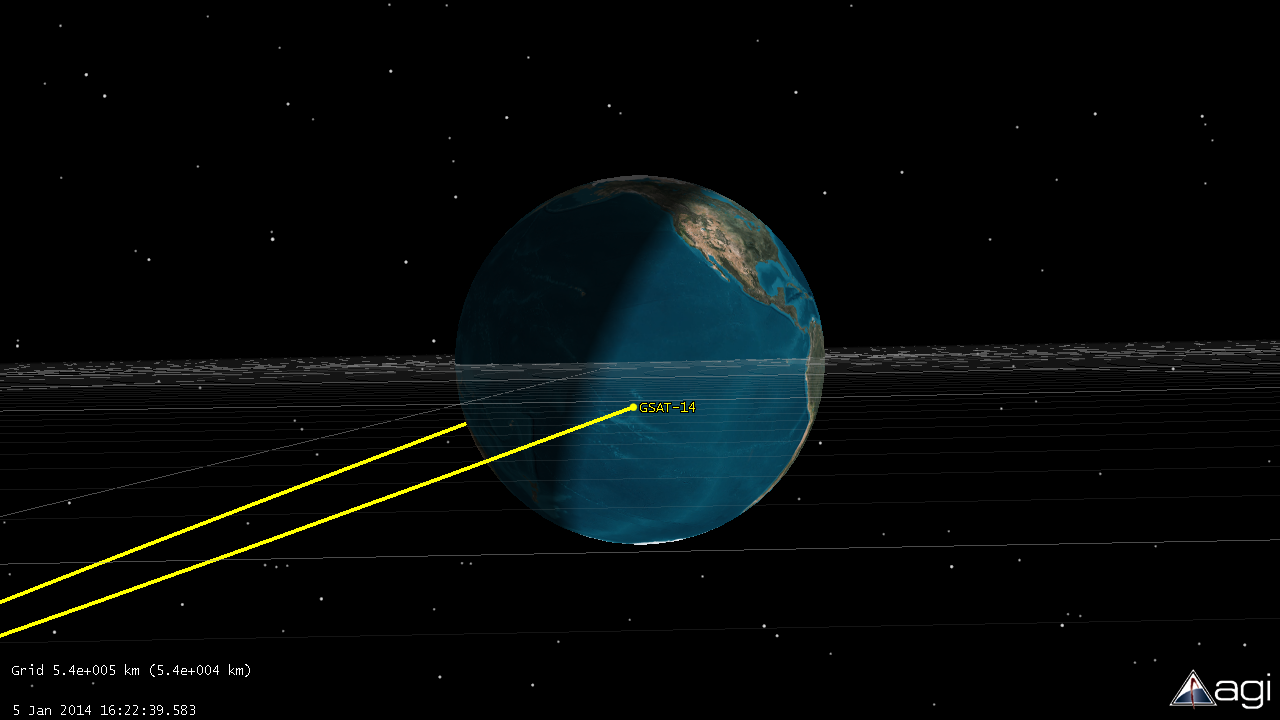
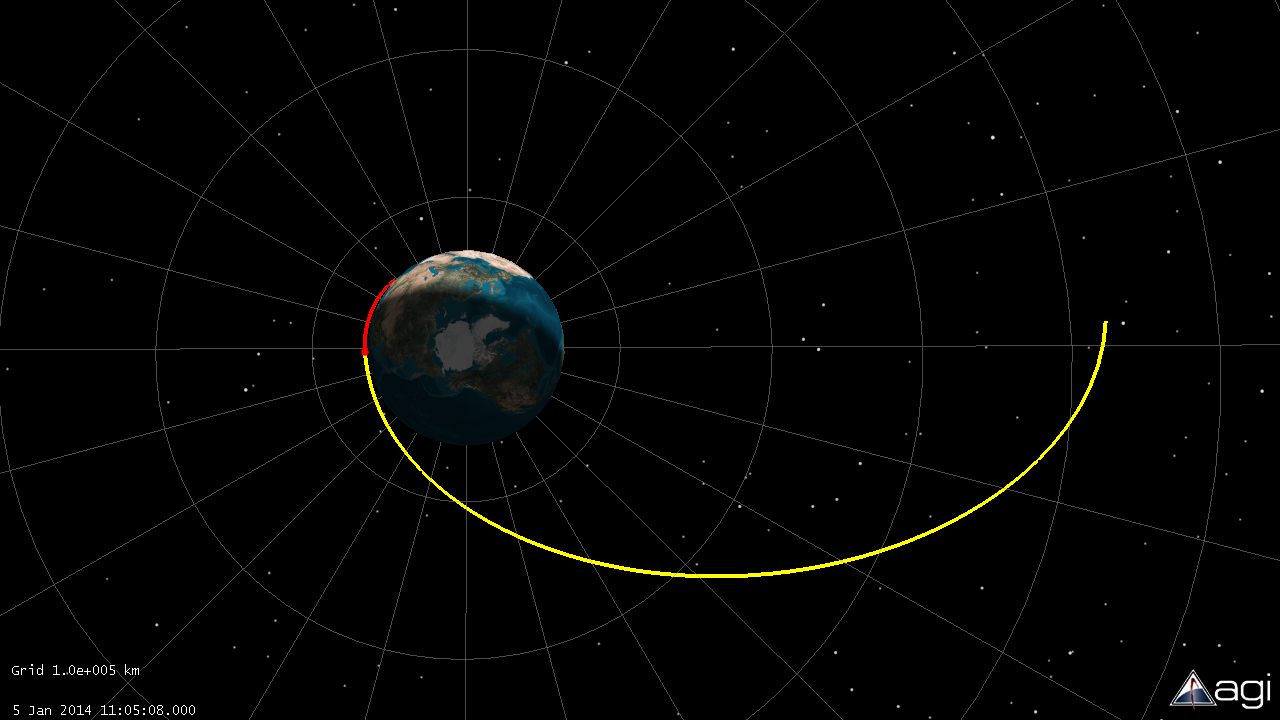
GSAT-14 now coasts as it dips beneath the equator to a latitude of 19.3 degrees (our inclination), and starts heading back north. As we cross the equator again, we’re at the ascending node, and we’re also at apogee, the highest point of our orbit—36,000 kilometers above the Earth. For perspective, the Earth’s radius is 6,400 kilometers and the average distance to the moon is 384,000 kilometers. In other words, we’re five-and-a-half radii above the planet, and roughly one-tenth of the way to the moon.
Here’s what that looks like from two different angles:
Mike Loucks / SEE
GSAT-14 approaching apogee
Mike Loucks / SEE
GSAT-14 first apogee
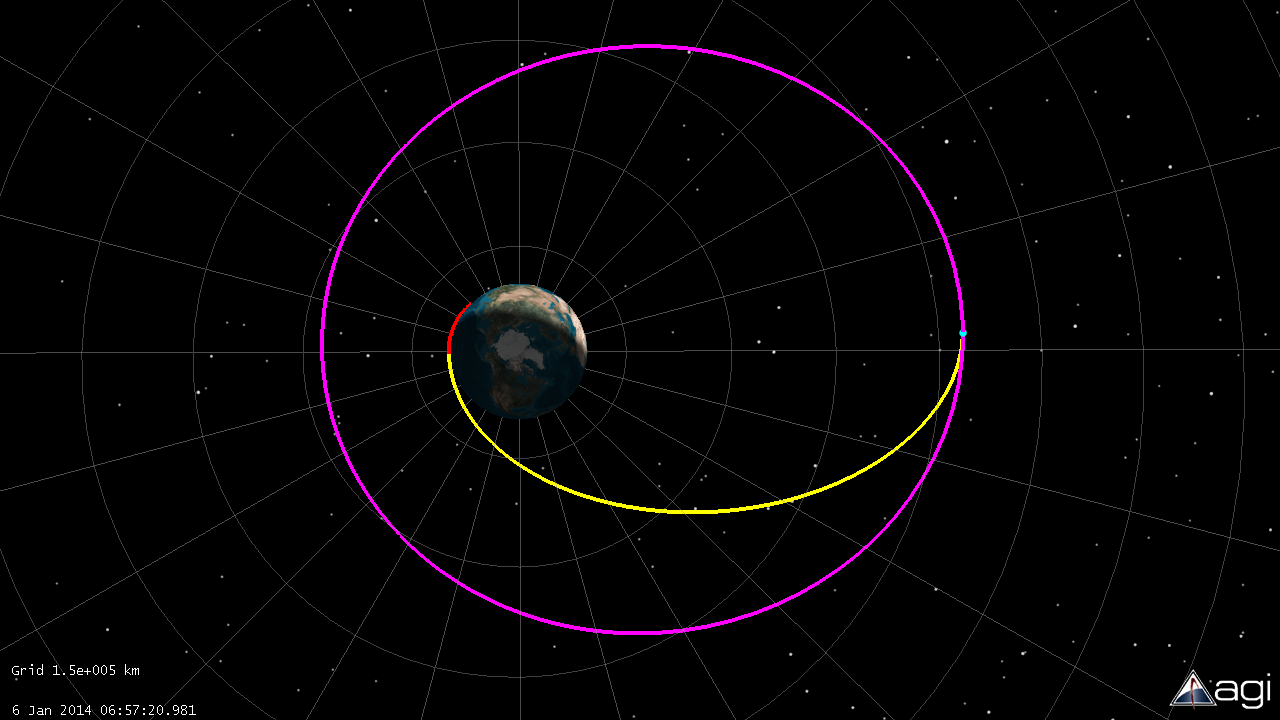
Our orbit is still fairly elliptical at this point. That’s no good—we want to circularize the orbit and lower its inclination to zero. We can accomplish both of these tasks by conducting a series of engine burns at apogee. According to the Indian Space Research Organization, GSAT-14 used three Apogee Motor Firings (AMFs) to get into its final orbit. For simplicity’s sake, we’ll assume a burn happens each time the satellite hits apogee.
Why do three burns, instead of one long burn? Mike says that in some cases, single, long-duration burns can be less efficient, and there may also be limitations on a spacecraft’s engines that prevent them from firing for too long. We’ll also assume each of the three burns gets us a third of the way to our final orbit.
After the first burn, our orbit becomes the pink line:
Mike Loucks / SEE
GSAT-14 after first engine burn (polar view)
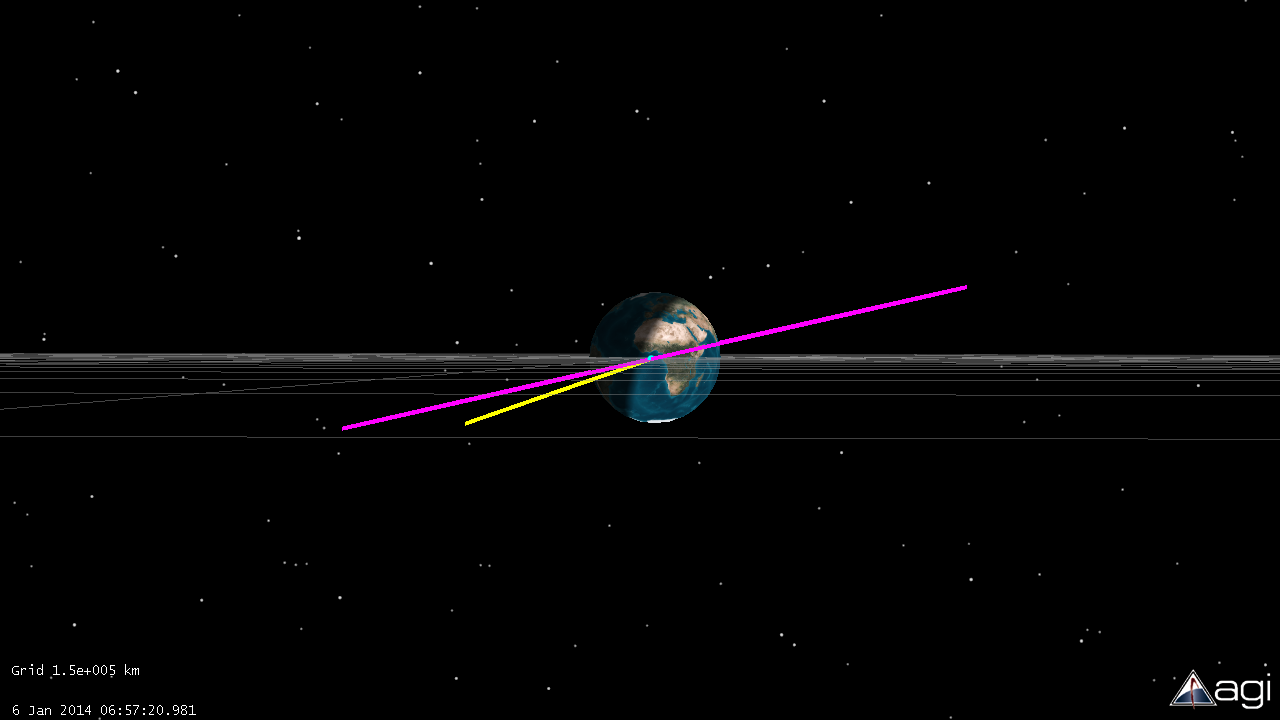
Mike Loucks / SEE
GSAT-14 after first engine burn (equatorial view).
After a second burn at apogee, our orbit becomes the teal line:
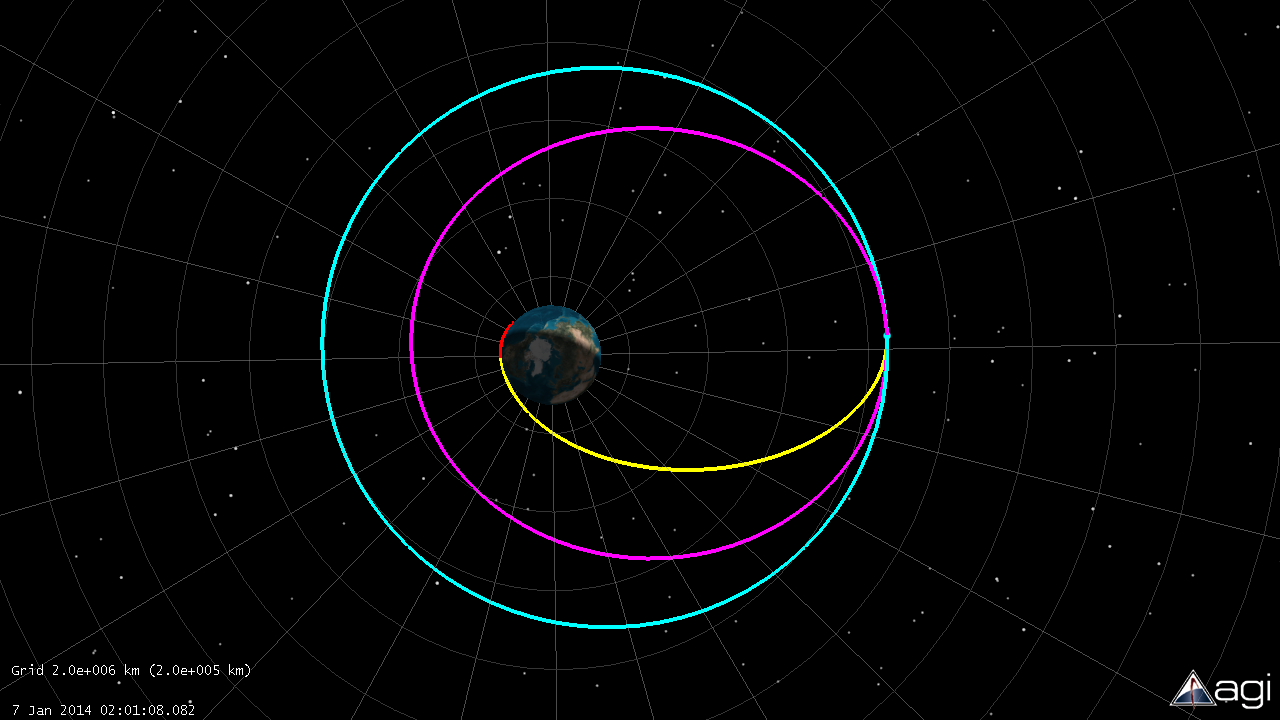
Mike Loucks / SEE
GSAT-14 after second engine burn (polar view)
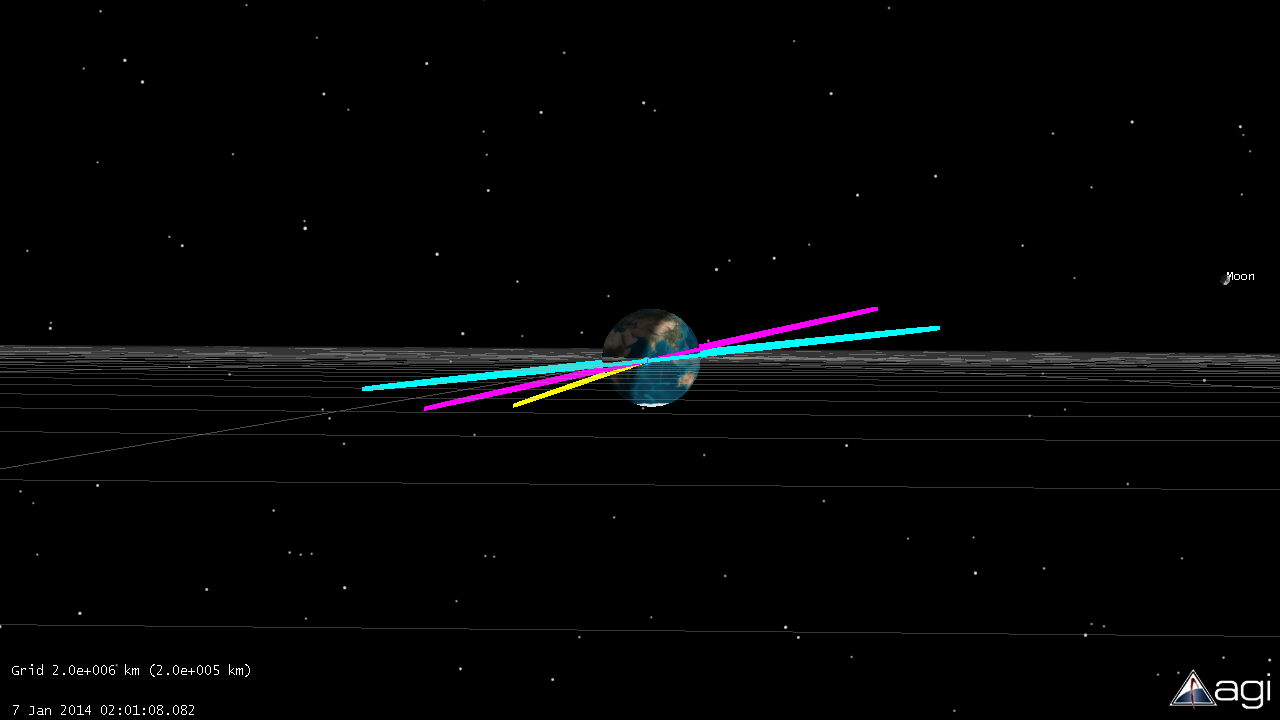
Mike Loucks / SEE
GSAT-14 after second engine burn (equatorial view)
And after a third burn at apogee, our orbit becomes the green line:
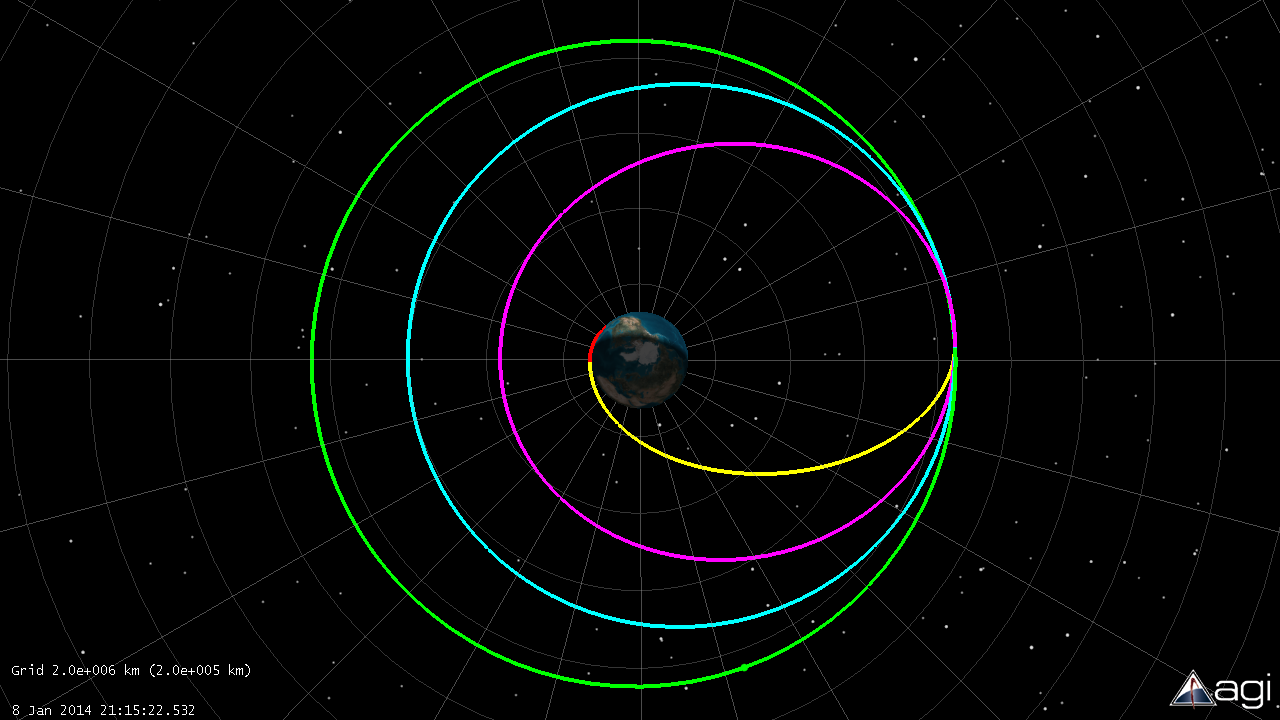
Mike Loucks / SEE
GSAT-14 after final engine burn (polar view).

Mike Loucks / SEE
GSAT-14 after final engine burn (equatorial view)
And there we are! One geostationary satellite roughly 36,000 kilometers high, positioned at 74 degrees East, ready to provide communications services to the people of India. Here’s a video that puts it all together:
Thursday, February 06, 2014
12th Auto Expo: launchers and newsmakers
Facelift of Superb and Yeti.

Skoda is back at
the expo with Yeti, which will be launched in the second half of 2014. The most
notable changes to the front are the wider grille and the bi-xenon headlamps
with LED daytime running lights incorporated into them. The bonnet and the
bumper are new as well. At the rear, the tail-lamps now get LEDs. The Indian
Yeti is based on the Yeti Outdoor version and that means, like before, it will
get black plastic cladding along the lower bits of the bumpers, side claddings
and side moldings.
Skoda also showcased the
facelifted Superb. The nip and tuck bring the Superb up to Skoda's new
family look with the butterfly grille, reshaped headlamps and foglamps,
re-profiled bumper and new bonnet. The bi-xenon headlamps come with integrated
LEDs and the top Elegance trim features power washers. At the rear, the
tail-lamps are part LEDs and the number plate has been moved to the boot-lid
from the bumper.
Mahindra's Halo.

The Indian auto-major Mahindra & Mahindra unveiled its concept
electric sports car 'Halo' which it expects to launch commercially in the next
three years. The company said depending on the support from the
Indian government for electric vehicle, Halo will be introduced in the country
but it could very well hit overseas markets first.
"This car has been fully designed and developed in India with all
indigenous technology," Mahindra Reva Electric Vehicle CEO Chetan Maini
said.
The company also introduced a quick recharge variant of its existing
electric car e20, equipped with smart port technology.
The car can be fully recharged in one hour, while a recharge of 15
minutes will give a range of 25 km.
Big Launches.
 Priyanka Chopra launched
Jaguar Land Rover's Range Rover LWB.
Priyanka Chopra launched
Jaguar Land Rover's Range Rover LWB.


Hero’s Splendor Pro
Classic
 Hero Motocorp's 620cc
Hastur
Hero Motocorp's 620cc
Hastur
Hyundai HND-9 Venace
concept car.
Wednesday, February 05, 2014
12th Auto Expo: Finally some revival by launches

Breaking the slowdown, BMW India unveiled four cars, including
BMW i8, which was first seen in 2012 in Hollywood flick 'Mission Impossible 4'. It
also launched all-new BMW 3 Series Gran Turismo at Rs 42.75 lakh,
all-new X5 and BMW M6 Gran Coup at the 12th Auto Expo 2014 in Greater
Noida. These cars from the BMW stable were unveiled by cricket legend Sachin Tendulkar.
The other launches were:


Hyundai Xcent. Hyundai Xcent, expected to be seen on Indian roads by March this
year, is among the four new models that the company plans to launch in the next
two years, including a compact sports utility vehicle (SUV), to enhance its
position in the market.
Hero HX250R. The HX250R is Hero’s first in-house built motor, after its
division from Honda. The company has R&D tie up with Eric Buell Racing and
AVL.

Ford Figo Concept. US auto major Ford Motor Co
unveiled its all new mid-sized sedan Fiesta and compact sedan Figo
Concept.
Suzuki Ciaz. India's car market leader Maruti Suzuki India unveiled Ciaz
and crossover SX4 S-Cross to enhance its position in the bigger sedan segment
going forward.

Bajaj RE 60. Awaiting a formal notification on quadricycle, Pune-based
Bajaj Auto said it is ready to roll out its RE60 model once it gets a go
ahead from the government.
Renault KWID. French car maker
Renault today made the global launch of its concept car KWID here
besides introducing new variants of models Fluence and
Duster.

Harley-Davidson Street 750. The world renowned bike maker Harley-Davidson today launched its
much-awaited and the most affordable model the Street 750 at a price of
Rs 4.1 lakh in the country.
DC also didn't lag behind in showing his creations.


Datsun, with its debut at the 12th
Indian Auto Expo showcased two production cars in the Go and Go+ and also world
premiered the Redi-Go crossover concept at the Expo fairground. The Redi-Go
concept focuses a potential small crossover for the model line-up. As most
crossover concepts, the Redi-Go is targeted at young people with active
lifestyles.

Monday, February 03, 2014
Auto Expo 2014: Bet on new models to revamp demand situation.
Being nightmare
by the downbeat following in 2013 in terms of sales, the companies are looking
ahead to unveil new models at the 14th
Auto Expo to create excitement among consumers weighed down by the gloomy
macroeconomic conditions and boost demand.

Friday, January 31, 2014
Automobile Lovers ! your darlings are back at 12th Auto Expo.

Delhi is again in news for some commercial reasons. The 12th edition of the Auto Expo, jointly organized by CII, SIAM and
ACMA, accredited by OICA and due to begin in the first week of February
is expected to revive the auto industry and give a fillip to the Indian
economy.
According to a CII statement, as many as 70 new vehicles will be unveiled, with 26 global unveilings of which 15 are cars.
The event will be attended by 1100 exhibitors in the motor show and about 55 exhibitors in the components show will display a staggering array of vehicles and components in much larger space and there will be a special theme pavilion to promote hybrid and electric mobility.
Vikram Kirloskar, President, SIAM, said that the last year was a very tough year for the auto industry on the whole with factors such as the slowdown in the economy, rising fuel costs, less disposable income and poor sentiment negatively affecting sales.
However, he said, the industry was optimistic and had been working very hard to produce better products to boost sales.
Stressing on the importance of the sector, he said the auto industry is the locomotive of growth for the Indian economy.
Addressing the gathering, Deep Kapuria, Past President, ACMA, said the auto components industry is recognized as a leading quality-oriented industry and that over the years, the value-add in components has risen.
On display at the Show will be over 500 plus new technologies and over 5000 products.
Describing the components sector as a "sunrise" sector, he said the sector has tremendous potential.
Describing it as a 'unique and special show', Chandrajit Banerjee, Director General CII, said that this is the first time that the show has been split into two - components and motor show -as the growth in the magnitude of the Show warranted it.
While the Components Show will take place from 6-9 February in Pragati Maidan, New Delhi, the Motor Show will take place from 7-11 February at Greater Noida, Delhi-NCR.
The expected footfalls in the Motor Show is about 1 lakh per day, and about 10,000 per day in the components show, which is primarily a B2B show.
According to a CII statement, as many as 70 new vehicles will be unveiled, with 26 global unveilings of which 15 are cars.
The event will be attended by 1100 exhibitors in the motor show and about 55 exhibitors in the components show will display a staggering array of vehicles and components in much larger space and there will be a special theme pavilion to promote hybrid and electric mobility.
Vikram Kirloskar, President, SIAM, said that the last year was a very tough year for the auto industry on the whole with factors such as the slowdown in the economy, rising fuel costs, less disposable income and poor sentiment negatively affecting sales.
However, he said, the industry was optimistic and had been working very hard to produce better products to boost sales.
Stressing on the importance of the sector, he said the auto industry is the locomotive of growth for the Indian economy.
Addressing the gathering, Deep Kapuria, Past President, ACMA, said the auto components industry is recognized as a leading quality-oriented industry and that over the years, the value-add in components has risen.
On display at the Show will be over 500 plus new technologies and over 5000 products.
Describing the components sector as a "sunrise" sector, he said the sector has tremendous potential.
Describing it as a 'unique and special show', Chandrajit Banerjee, Director General CII, said that this is the first time that the show has been split into two - components and motor show -as the growth in the magnitude of the Show warranted it.
While the Components Show will take place from 6-9 February in Pragati Maidan, New Delhi, the Motor Show will take place from 7-11 February at Greater Noida, Delhi-NCR.
The expected footfalls in the Motor Show is about 1 lakh per day, and about 10,000 per day in the components show, which is primarily a B2B show.
For the complete loop of Auto Expo you can visit the official website of the Expo. If you also plan to visit the Expo, the details of ticket are available here
Subscribe to:
Posts (Atom)